

Why Microelectronics Filtration Demands Extreme Purity
Semiconductor fabrication relies on process fluids that are free of particles, ions, and microbial contaminants. A single particle larger than a few nanometres can short-circuit a logic gate or create a pinhole in a wafer coating, destroying value that took dozens of steps to build. This is why microelectronics filters are engineered to remove particles at the sub-0.1 µm scale, and for ultrapure water (UPW) loops the target is often 0.003 µm or finer. The filtration requirements are orders of magnitude stricter than those in general industrial water treatment because the damage threshold is so low.
The environments in which these filters are produced and installed also matter. Cleanrooms classified under ISO 14644-1 (the international standard for airborne particulate cleanliness) help ensure that the filter itself does not become a source of contamination. When evaluating a filter supplier, it is reasonable to ask whether its manufacturing facility operates under a documented cleanroom protocol and what classification level is maintained.
Key Criteria for Selecting Microelectronics Filters
Micron rating and retention efficiency. The first specification to check is the filter’s rated pore size. For UPW circuits, absolute-rated filters at 0.05 µm or 0.003 µm are common. For process chemicals and photoresist solvents, the required rating depends on the fluid viscosity and the contaminant profile. A filter that performs well in water may not achieve the same retention in a high-viscosity solvent.
Material compatibility and extractables. Semiconductor process fluids include strong acids, bases, and organic solvents. The filter media and support layers must resist chemical attack without shedding particles or leaching ionic contaminants. Common materials are PTFE, PVDF, PES, and polypropylene. The housing material — often stainless steel or a fluoropolymer — must also be compatible. Low extractables are critical: any substance that migrates from the filter into the fluid can disrupt downstream processes.
Cleanroom compatibility of the filter element. Filters destined for semiconductor cleanrooms are typically double-bagged and manufactured in a controlled environment. Suppliers that produce microelectronics filters in classified cleanrooms can provide a higher level of assurance that the product will not introduce particulates during installation or operation.

Filter Types and Materials for Semiconductor Processes
Different points in a semiconductor plant call for different filter formats.
- Pleated cartridge filters offer a large filtration area in a compact footprint, making them suitable for high-flow UPW loops and bulk chemical recirculation.
- Membrane filters provide absolute retention ratings and are used at point-of-use locations where any particle breakthrough is unacceptable.
- High-flow filters with gradient pore structures are common in RO pre-treatment and condensate polishing, where flow rate and dirt-holding capacity are priorities.
Material choice follows the chemical environment. PTFE and PVDF are specified for aggressive chemistries such as hydrofluoric acid or hot UPW. Polyethersulfone (PES) is widely used in less aggressive streams because of its low protein binding and good flow characteristics. Nylon and polypropylene are cost-effective options for neutral pH fluids. Each material should be validated for low extractables and ionic cleanliness before being deployed in a semiconductor process.
Testing and Validation: What to Look For
A supplier that can document filter performance with independent test methods offers more confidence than one that provides only a nominal micron rating. Key validation techniques include:
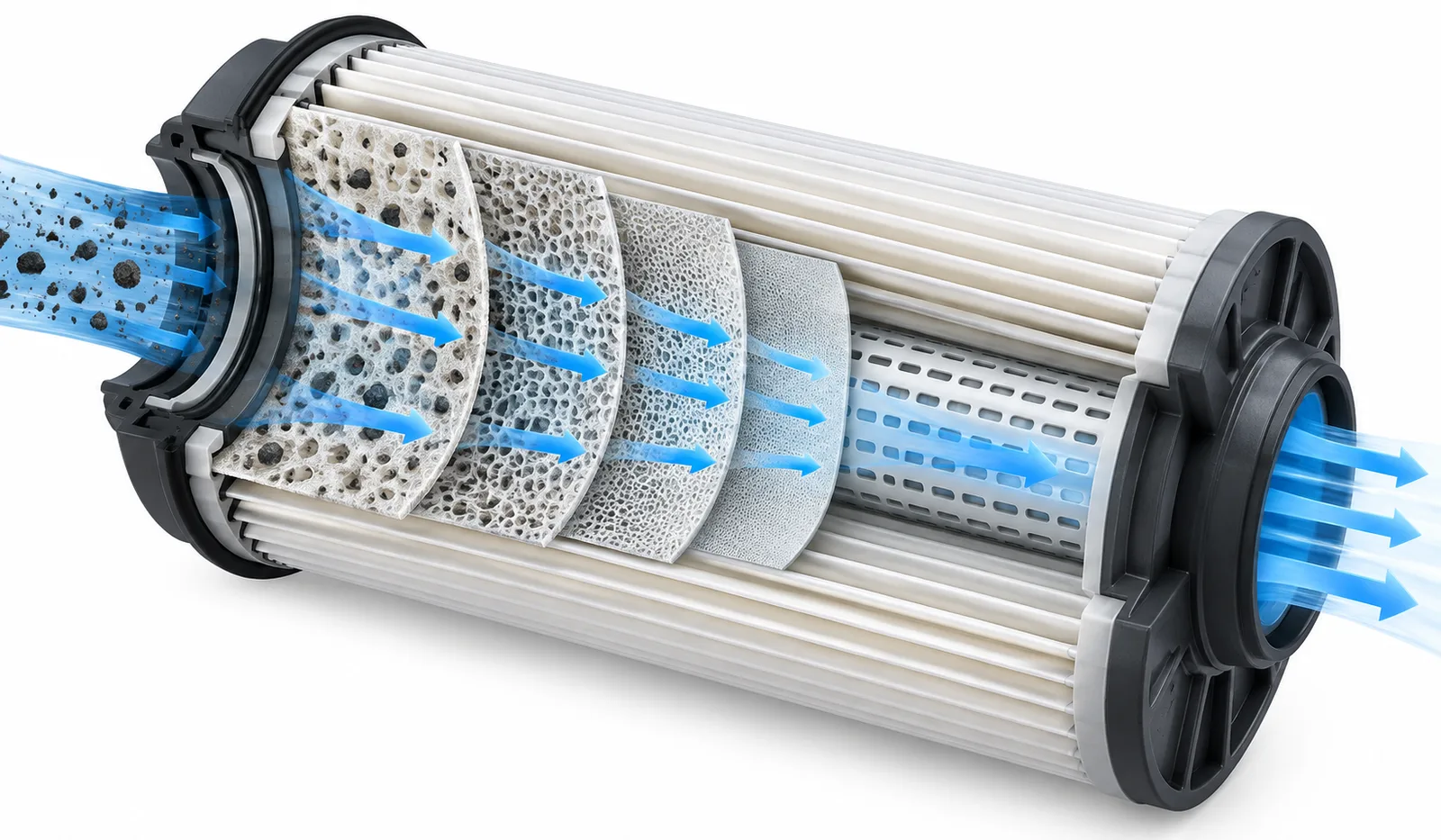
- Bubble point integrity testing, which confirms that the largest pore in the filter does not exceed the specified size.
- Particle challenge testing (e.g., with latex spheres or bacterial challenges) to verify retention efficiency under simulated use conditions.
- Scanning electron microscopy (SEM) to examine media morphology and confirm consistent pore structure.
- Ion chromatography and ICP‑MS to measure extractable anions, cations, and metals.
Pullner, for example, lists PMI (porous materials characterization), SEM, ion chromatography, and ICP‑MS among its in-house test capabilities, and states that its membrane pore analysis spans from 3 nm to 150 µm. Laboratory data of this kind allows process engineers to match a filter’s performance envelope to their specific fluid and particle challenge.
Evaluating a Microelectronics Filter Supplier
Beyond product specifications, consider the supplier’s production scale, quality management system, and global logistics. ISO 9001 certification signals that the manufacturer follows documented procedures for quality control and batch traceability. A supplier with multiple production lines and a stated capacity of thousands of elements per day is better positioned to support consistent lead times.
Pullner, headquartered at LB19-Office No.1207, Jebel Ali Free Zone in Dubai, operates a 15,200 m² facility with cleanroom production and more than 30 production lines. The company’s LinkedIn profile indicates a founding year of 2013 and a workforce of 51–200 employees. While the company offers microelectronics filtration solutions and maintains laboratory capabilities relevant to semiconductor applications, independent certifications specific to the semiconductor industry (such as SEMI F57 for UPW filter performance) are not listed on its public materials. Buyers should request current test reports and certification documents during the evaluation process.
For authoritative background on cleanroom classification, refer to the ISO 14644-1 standard. For industry‑specific filtration guidelines, the SEMI standards portfolio includes documents covering ultrapure water and process chemical filtration. Consulting these references can help you build an informed specification sheet before engaging any supplier.